The Autonomous Software Factory
How AI agents are building the next industrial revolution — and what it means for everyone who makes software

It’s 3am. The office is empty. The espresso machine is cold. The whiteboards still have last Tuesday’s sprint planning on them, half-erased.
But something is running.
In a data center humming somewhere between here and the cloud, hundreds of AI agents are writing code. They’re opening pull requests. Running test suites. Catching regressions. Flagging dependencies. Committing changes to repositories that nobody is watching. They will do this all night, and all day tomorrow, and through the weekend. They don’t get tired. They don’t negotiate scope. They don’t ask for a meeting to clarify the requirements.
The software factory never clocks out.
This image — autonomous, relentless, tireless production — is the one the tech industry keeps dancing around without quite naming. We talk about “AI-assisted development” and “agentic coding tools” and “the future of engineering.” But what we’re actually building, slowly and somewhat accidentally, is an autonomous factory. And like the factories of the Industrial Revolution, it will transform not just how things are made, but who makes them, what roles exist around the making, and what it means to be good at your job.
The difference, of course, is that this factory doesn’t smell like coal dust. It runs from a fourth-floor open-plan office in Mountain View, Sunnyvale, or Palo Alto, where the coffee costs nine dollars and the parking costs more. The foremen wear hoodies. The machinery is invisible. But make no mistake: the production line is real, it’s being installed right now, and the path to get there is more complicated than it might appear from a distance.
I’ll admit something: in a recent piece on the energy-compute-robotics flywheel, I mapped a technology stack that stretches from semiconductor fabs to humanoid robots — a vision of recursive, self-amplifying physical production that makes the software factory look like a modest intermediate step. I treated what I’d now call Stage 3 — the coordinated, factory-scale use of AI in software production — almost as a given. A layer to name-check before moving on to more exotic terrain. But sitting with that framing afterward, it felt like glossing over something important. Because for the organizations where most of us actually work — large, complex, legacy-laden enterprises — the software factory is not a given. It’s not a solved problem. It’s a significant technical and organizational undertaking that most companies are still in the early stages of figuring out. That gap between “this is clearly where things are going” and “here is what it actually takes to get there” is what this article is about.
What a Software Factory Actually Is
Before we get ahead of ourselves, let’s define the thing we’re talking about — because “AI coding tools” and “software factories” are not the same thing, and the gap between them matters enormously.
It helps to think about AI adoption in software development as a maturity spectrum with three broad stages. Most organizations aren’t neatly in one box — they’re somewhere on the continuum, with different teams at different levels — but the stages give you a useful map.
Stage 1: AI-Powered Knowledge Work. This is where virtually everyone started in 2023-2025. Developers and PMs use ChatGPT, Claude, or Gemini to write documentation, answer technical questions, draft emails, summarize meetings, and generate first drafts of requirements. The output is text. The human still does all the building. This stage delivers real productivity gains, but it doesn’t change the fundamental structure of how software gets made. The craftsperson now has a very good reference book.
Stage 2: Agentic Developer Tooling. Here, AI starts touching the code directly. Tools like Antigravity, Copilot, Cursor, and Claude Code work inside the development environment — autocompleting functions, suggesting refactors, generating evals and test cases, even implementing entire features from a natural language description. The developer is still in the loop on every meaningful decision, but they’re spending far less time on mechanical execution and far more time on review, architecture, and judgment calls. (I went deep on what this stage feels like from a PM’s perspective here.) This is where a large portion of the tech industry currently sits — and the productivity differential between Stage 2 teams and Stage 1 teams is already significant.
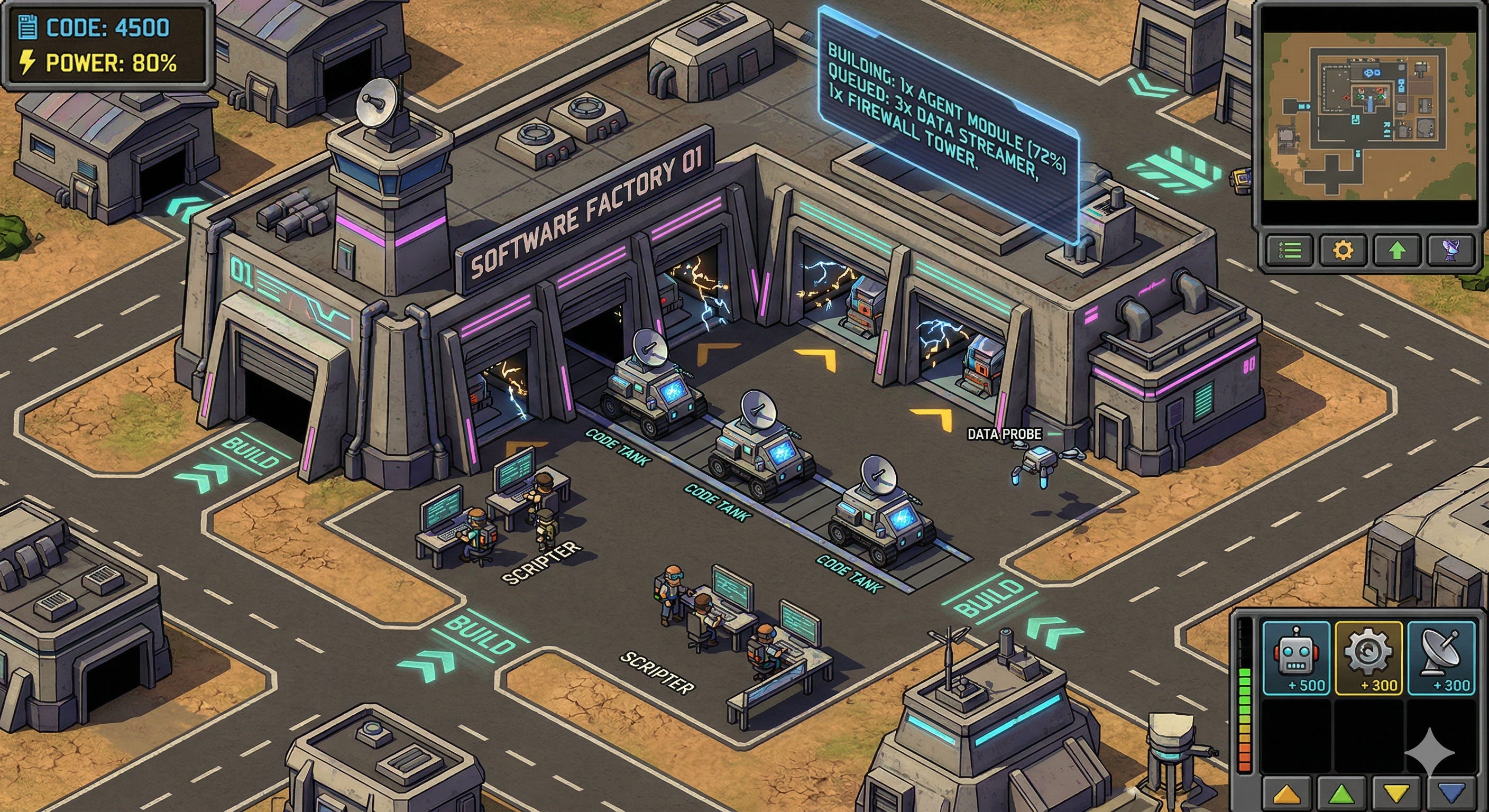
Stage 3: The Software Factory. This is the stage this article is about. It’s not just AI helping a developer — it’s a coordinated pipeline of AI agents, each with a defined role, working in sequence (and sometimes in parallel) to produce, validate, and ship software with minimal human intervention at each step. There’s an orchestration layer that acts as the foreman — routing work, managing context, deciding what gets done in what order. Coding agents produce the actual code. QA agents run tests and flag failures. Review agents check for security issues, style violations, or logical gaps. CI/CD pipelines act as the conveyor belt — moving finished goods from development into production. Humans set direction, review outputs at key gates, and handle the judgment calls that require genuine understanding of the business. The rest runs continuously.
How the machinery actually works
The question people always ask is: how does the factory know what to work on next?
The dominant architecture emerging across the industry is the orchestrator-worker pattern. A lead agent — typically a powerful frontier model — acts as the foreman. It receives a task (a ticket, a feature request, a bug report), analyzes the scope, breaks it into subtasks, and delegates each subtask to specialized worker agents. The workers run in isolated context windows, execute their piece, and report results back to the orchestrator. The orchestrator synthesizes, decides if the work is done or needs another pass, and advances the pipeline.
No single company has published a complete, production-hardened version of this at enterprise scale — yet. But the blueprint is increasingly clear from the teams that are furthest along. In practice, a factory-scale pipeline looks something like this:
1. Input — Work enters the system. A ticket from a project management tool, a feature spec from a PM, a bug report from monitoring. This is the raw material.
2. Orchestrator (the foreman) — A lead agent triages the input: what kind of work is this? How complex? What files are involved? It produces a plan — a set of subtasks with dependencies — and assigns each to the right worker.
3. Coding agents (the workers) — Specialized agents write the code. Each operates in an isolated workspace — its own branch, its own context — so multiple agents can work in parallel without corrupting each other’s changes. This is the same branching model human developers use, just running faster and in greater volume.
4. Validation layer — QA agents run tests, check for regressions, verify the output against the spec. Review agents check for security issues, style compliance, and logical coherence. This layer is where a significant portion of the work should be deterministic — automated test suites, linters, static analysis — rather than agent-driven. Early production systems have found that roughly 40% of pipeline steps need agent judgment, while 60% are better handled by conventional scripts. Using an agent where a bash script would do is more expensive and less reliable.
5. Human review gate — At defined checkpoints, the pipeline surfaces work for human inspection. Not every change — that would defeat the purpose — but changes that cross a risk or complexity threshold. A PM reviewing whether the feature matches intent. A security engineer reviewing changes to authentication code. A senior engineer reviewing architectural decisions. The factory runs continuously; the humans approve at gates.
6. Merge and deploy — Approved changes merge to main and flow through CI/CD into production. The conveyor belt delivers finished goods.
7. Failure handling — When something breaks — a test fails, a merge conflicts, an agent produces output that doesn’t pass review — the system classifies the failure as retryable or terminal. Retryable failures go back into the queue with backoff. Terminal failures go to a dead-letter queue for human triage. The factory doesn’t stop when one item fails; it routes around the failure and keeps producing.
The orchestrator decides what happens next based on the state of each work item — where it is in the pipeline, what’s blocking it, what prerequisites are satisfied. Think of it less like a traditional task queue and more like a state machine: each unit of work advances through defined states (planned → implementing → testing → reviewing → deploying), and the orchestrator’s job is to keep everything moving forward, catch what stalls, and escalate what it can’t resolve.
This pattern isn’t theoretical — but it’s also not yet running at full enterprise scale outside a few cos on the bleeding edge. The major AI labs are closest, using variations of it internally. Large tech companies have deployed Stage 2 agentic tooling across tens of thousands of engineers and are actively building toward coordinated Stage 3 pipelines. And smaller teams like Frequency have published detailed production accounts of running 10 agent pipelines managing 30 applications 24/7 — including the hard-won lessons about concurrency control, stale worktrees, and the reality that agent output quality varies enough run-to-run that you can’t predict throughput precisely. The pieces exist. Assembling them into a reliable, governed, enterprise-grade factory is the work in progress.
A caveat worth stating clearly: the factory’s output quality is bounded by the models that power it. I’ve written before about my skepticism that current LLMs represent a direct path to general intelligence — they’re extraordinary pattern matchers, but pattern matchers nonetheless. I expect there to be some significant breakthroughs architecturally before reaching AGI. And anyone who’s worked with multiple models knows they’re spiky. A factory that runs dozens of agents at scale has to contend with model selection, task-specific strengths and weaknesses, and the reality that “fast” and “correct” are not always the same thing. The factory is powerful. It is not infallible. The humans in the loop exist for a reason.
The fuel powering all of this is tokens — the fundamental unit of AI computation. Every line of code generated, every test written, every pull request reviewed consumes them. Today’s frontier models process millions of tokens per context window. An enterprise running agent pipelines at scale burns billions of tokens per day. Token costs are falling fast, following a curve that looks a lot like the historical cost curves of electricity and compute — which is to say, they’re declining fast enough that consumption is expanding even faster than the price is dropping.
That dynamic — falling unit costs, exploding consumption — is exactly how industrial-era factories scaled. Steam power got cheaper. Mills didn’t run the same number of looms more efficiently. They ran ten times as many looms.
We are in the early innings of that phase for software.
The Artisan Shops Are Not the Story
You’ve already heard about the startups. The tiny teams shipping enterprise-grade products in weeks. The solo founders generating tens of thousands of lines of production code in stolen hours. (I wrote about my own version of this.) The YC batches where half the companies have more AI agents than human engineers. These stories are almost cliché now — which is itself a sign of how fast things have moved.
These stories are real, and they’re genuinely impressive. But they’re not the software factory story. They’re the artisan shop story.
In the early 1800s, before the great textile mills of Lancashire dominated global production, there were thousands of skilled hand-loom weavers operating out of small workshops and cottages. They were productive. They made beautiful things. Some of them adopted early mechanization and dramatically outpaced their neighbors. But they weren’t factories. They couldn’t produce at the scale, consistency, or cost structure that the factories eventually would. The cottage industry was a preview, not the destination.
Startups today occupy a similar position. A small, skilled team with AI tools can move shockingly fast — but they’re typically working on greenfield projects, fresh codebases, and small teams who share full context. None of the organizational weight that comes with building software inside a large enterprise. They can iterate at the speed of thought precisely because there’s no legacy to manage, no compliance review board, no seventeen stakeholders who need to sign off on the API contract. While some of them create mission critical applications, most are not at risk of taking down a Fortune 500 company due to a security blunder.
The more consequential question — the one that affects the majority of people who build and manage software — is what happens when the factory model takes hold at enterprise scale. In organizations with hundreds or thousands of engineers, decades of existing systems, and complex regulatory environments. That transition is underway, at different speeds in different places, and navigating it thoughtfully is one of the defining challenges for technology leaders right now.
Retrofitting the Factory Floor
The machines have arrived. The question is how quickly, and how well, they get integrated.
The productivity gains from Stage 2 — agentic developer tooling — are real and measurable. I’ve experienced them firsthand, and in the right conditions — greenfield projects, common tech stacks, small teams with full context — they can be genuinely transformational. But I also noted at the time that those gains compress significantly when you’re dealing with legacy monoliths, safety-critical systems, and complex multi-team coordination. That caveat turns out to be the whole story at enterprise scale. Individual productivity gains and a coordinated agent pipeline are not the same thing. One is a weaver with a better shuttle. The other is a mechanized mill. The gap between them is architectural, organizational, and cultural — not primarily a technology problem. The technology largely exists.
Architecturally, enterprise codebases are complicated in ways that greenfield projects are not. Decades of accumulated decisions, framework migrations, acquired company integrations, and undocumented tribal knowledge make it much harder to point an agent at a task and trust the output. The “factory floor” — the existing codebase — is full of what you might politely call historical character. Less politely: asbestos. Agents can generate code at extraordinary speed, but validating that code against the full complexity of an enterprise system requires either very good context-loading (expensive in tokens and latency) or very careful scoping of what agents are allowed to touch.
Organizationally, enterprises are working out the governance model. Who owns the agent pipeline? Engineering? Platform teams? A new AI infrastructure function? And critically: when an AI agent writes a bug that causes an incident, who is accountable? These questions don’t have clean industry-standard answers yet, and large organizations move deliberately when the answers aren’t clear.
The spectrum here is real. The AI labs themselves — Google DeepMind, OpenAI, Anthropic, and others — are the furthest along, and it’s not hard to see why. They have effectively unlimited access to their own frontier models, they’re among the largest consumers of tokens on the planet, they’re building on greenfield or modern codebases, and their engineering cultures were born in the agentic era. They operate less like traditional tech companies and more like startups with enormous resources — moving at startup speed but at meaningful scale. In many ways, they’re the first true software factories. But their advantage is structural: most enterprises cannot yet afford to burn tokens at the rate an AI lab does, and won’t be able to until costs fall further. The rest of the tech-native world — companies with modern infrastructure, strong platform cultures, and engineers who’ve already moved through Stage 2 — is further behind but closing the gap, and the leading ones are already running meaningful factory-scale pipelines in at least parts of their stack. Traditional enterprises in regulated industries are earlier still — some are consolidating Stage 2 gains, but a surprising number are still bumbling around in Stage 1, treating ChatGPT as the extent of their AI strategy while their competitors are installing the machines. The timeline to full factory-scale operation will vary by years across different types of organizations — but the direction is uniform. The companies that figure out the architecture and governance questions first will have a durable competitive advantage. The ones that treat Stage 2 as the destination risk the same fate as manufacturers who kept running manual operations well into the age of electrification: not failing immediately, but falling further behind every year.
The New Bottlenecks
Here’s a tension that doesn’t get talked about enough: the factory can produce at industrial scale, but it then feeds directly into a review and release process that was designed for foot traffic.
Code review is the most visible example. Many large organizations — for very good reasons rooted in quality, security, and accountability — require human sign-off before code gets merged. That policy made complete sense when a productive engineer might open five to ten pull requests in a week. It starts to buckle when an agent pipeline is generating hundreds. The reviewer becomes the bottleneck. The factory floor is humming, the conveyor belt is loaded, and everything is stacked up waiting for one human to click approve.
It goes deeper than review throughput. Many large organizations have built layers of automated checks that run before code can be submitted: linters, style checkers, static analysis, formatting enforcement. These systems were designed to catch the kinds of mistakes humans make — and they’re good at it. But they start to feel like a different problem when an agent can generate 10,000 to 20,000 lines of change in a single run, and half the failures are style violations that the agent could fix in seconds but that still consume CI time and human attention to triage. Infrastructure built to maintain standards becomes infrastructure that throttles the factory.
This is not an argument for abandoning code review or quality standards. It’s an observation that the tooling and process assumptions baked into enterprise software delivery were calibrated for a pre-factory world, and most organizations haven’t yet reckoned with what needs to change. The smart ones are starting to ask which parts of their review process are genuinely about catching meaningful problems — and which parts are ceremony that made sense once and now just adds friction.
There’s a deeper question lurking here: if agents are increasingly writing, reviewing, and maintaining code, how much of our investment in human-readable source code still makes sense? We’re nowhere near abandoning it — human oversight still matters enormously. But the conventions we built around readability were built for a world where humans were the primary authors and readers of code. That world is changing faster than our standards have absorbed.
What Happens to the People on the Floor
This is the part that matters most to anyone working in or around software development right now — and it deserves a clear-eyed treatment.
The Industrial Revolution didn’t eliminate labor. It reorganized it, concentrated it, elevated some skills, and made others obsolete. Mill towns grew. New trades emerged. But the transition was real, uneven, and often brutal for individuals even when it was beneficial at a macro level.
The software factory will reorganize labor too. Here’s how the major roles are shifting:
Engineers and Designers are moving from primary producers to machine supervisors and systems architects. Writing code from scratch is already, for many tasks, giving way to reviewing, validating, and refining AI-generated code. The engineers who thrive will be the ones who can reason about large systems, catch subtle failures, and maintain taste about what good software looks like — even when they didn’t write every line of it. The highest-value engineering work was always about judgment, not typing speed. That’s becoming more true, faster.
QA and testing is undergoing perhaps the most radical transformation. Routine regression testing, test case generation, and coverage analysis are exactly the kind of structured, rule-bound work that AI agents handle well. The human QA function shifts toward adversarial thinking — finding the edge cases, the failure modes, the abuse scenarios that agents won’t naturally think to test for. This is actually more interesting work than running the same test suite for the fifteenth time. But it requires a different mindset.
Program and Project Managers are, in some ways, the role best positioned to absorb the factory model — because coordination, sequencing, and keeping complex systems of people and work on track is exactly what they’ve always done. The factory doesn’t change that mandate; it extends it. Now the dependencies to manage include agent pipelines alongside human teams. The blockers include model failures and context window limits alongside the usual resourcing and API contracts. In large organizations, this function doesn’t shrink with the software factory — it becomes more critical. The number of moving parts increases dramatically: more parallel workstreams, more integration points, more places where an automated pipeline can stall or produce unexpected results. Someone has to own the coordination layer — tracking what the factory is producing, what’s blocked, what shipped, and what needs human intervention. That’s the program manager.
Product Managers are being pushed toward something different — and, arguably, more powerful. The PM role has always sat at the intersection of the technical and non-technical worlds: translating user needs into buildable things, and translating technical realities back into business decisions. The software factory doesn’t eliminate that function. It amplifies it. When the factory can produce code faster than any team could historically review it, the bottleneck moves decisively upstream — to the question of what should be built, in what order, for whom, and why. That’s the PM’s domain, and AI gives PMs genuine superpowers to operate in it. The ability to prototype, validate, and iterate on ideas without waiting months for engineering capacity; to understand agent pipeline design well enough to shape what the factory produces; to function as an Agentic Product Architect rather than a specification writer. The PM who learns to work at this level doesn’t get automated. They become the person the factory works for.
Security and compliance functions are becoming dramatically more important — and dramatically more under-resourced. A software factory that generates code at high velocity is also generating risk at high velocity. Vulnerabilities that would have taken a human team months to introduce can now be introduced at industrial scale if agents aren’t properly constrained. The factory inspector role — someone who understands both the regulatory requirements and the technical realities of agent-generated code — is one of the most valuable and most underdeveloped roles in the current transition.
Engineering leadership — CTOs, VPs of Engineering, Director-level managers — are being asked to manage something that didn’t exist in their mental models when they built their careers. A hybrid org of humans and agents, where the ratio is shifting over time, requires a different kind of operating model. Capacity planning looks different when your “engineers” include autonomous agents. Headcount conversations get complicated. The org chart, as a concept, starts to strain.
The throughline across all of these changes is the same one that ran through every major industrial transition: the workers who understood the machine — not just how to use it, but how it worked, where it failed, and what it couldn’t yet do — were the ones who remained valuable throughout the transition and after it.
The Plush Office Paradox
There’s something almost comedically at odds about the image of a software factory running from a modern tech campus. The Industrial Revolution’s factories were visible. You could see the chimneys. You could hear the looms. The danger was physical and present. Workers lost fingers. Managers walked the floor.
Today’s factory is invisible. The risk isn’t physical — it’s a misconfigured agent that runs up a $200,000 token bill over a weekend, or a subtle logic error introduced at scale across a thousand microservices, or a security vulnerability baked into auto-generated code that nobody carefully reviewed. The foreman used to walk the floor. Now the floor is a Dashboard, and the foreman is whoever happens to be on call.
This isn’t an argument against the software factory. The benefits — speed, scale, cost, the ability to compress months of development into weeks — are too compelling to dismiss, and the economic pressure from competitors who are already moving in this direction is too real. But it is an argument for humility about what we’re building and how well we currently understand it. I’ve written separately about the stakes of removing human oversight from autonomous AI systems in far more consequential domains — and while a software factory doesn’t carry the same risks as autonomous weapons, the underlying principle holds: systems that operate at machine speed without human checkpoints will eventually produce outcomes nobody intended. The risks of the AI-age factory are real; they’re just different in character from the risks of the industrial one.
The most important thing that happens in those plush offices isn’t the code that gets shipped — it’s the judgment that gets applied to the process. What should the factory produce? How fast? With what guardrails? Where does human review remain non-negotiable? These are not engineering questions. They are product questions. They are leadership questions. They are, ultimately, human questions. And they matter more, not less, as the machinery becomes more capable.
What to Do Right Now
If you’re a product manager at a large company, here’s the honest read on your near-term situation:
Your organization is somewhere on a spectrum between “still mostly artisan” and “starting to install the machines.” Very few large enterprises are running true factory-scale agent pipelines yet. But the direction is clear, and the window in which you can develop expertise and influence before the transformation accelerates is finite.
Three things are worth prioritizing now.
First, get genuinely fluent in how agent pipelines work — not at an implementation level, but at a design level. You don’t need to write the orchestration code. You need to be able to sketch the workflow: what gets automated, what stays human, how errors get caught, what the escalation path is. This is increasingly the core PM skill in this space, and it’s different from anything in the traditional PM toolkit.
Second, start asking — and advocating for clear answers to — your organization’s factory roadmap. Where is your team in the transition? What’s blocking the move from individual AI tools to coordinated pipelines? Is it governance? Is it architecture? Is it a culture question? Understanding the actual constraints, not just the aspirational vision, is what lets you make useful contributions to moving things forward.
Third, invest in the human-in-the-loop layer, because that’s where product judgment lives. As code generation scales, the bottleneck moves up the stack — from “can we produce this?” to “should we, and is it right?” The PM who can answer that question well, at the velocity a software factory demands, is not a PM whose role is shrinking. It’s a PM who has become more central to the process than ever.
One More Thing
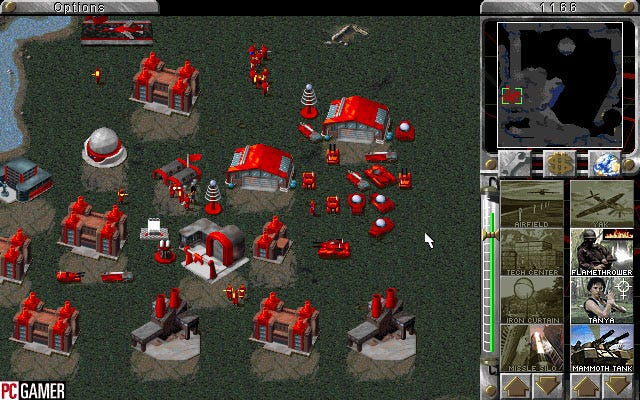
One thing I keep coming back to: this factory would be fascinating to visualize. Not as a monitoring dashboard with charts and latency graphs — but as something genuinely spatial and dynamic. The mental model I keep returning to is the classic Westwood real-time strategy games — Command & Conquer, Red Alert. Units moving with purpose. Resources flowing. Production queues ticking down. The satisfying clarity of seeing a complex system operating at a glance. For the engineers in the audience, you’ll recognize an even more apt reference: Factorio, the factory-building game that has consumed an embarrassing number of hours for a significant portion of the software industry. The parallels are almost too good — resource inputs, production chains, throughput bottlenecks, the compulsive need to optimize the pipeline. It basically is a software factory. Writing this article helped clarify the core primitives — orchestrators, workers, state machines, human gates, failure queues — but translating those into something visually legible and genuinely useful as a real-time interface is a harder design problem than the architecture itself. And it shouldn’t just be a visualization — it should be a control surface for the decisions the factory can’t make for itself. Reprioritize what the factory works on next. Approve or reject at human review gates. Triage failures the system has escalated. Adjust resource allocation when strategic priorities shift. The factory runs autonomously — but someone still needs to command it. The RTS comparison isn’t just aesthetic; it’s functional. If you’ve thought about this, or have opinions on what the right visual abstractions are, I’d love to hear them. Reach out.
This isn’t just a side project interest. Since returning from baby bonding at the end of January, I’ve been deeply involved in this problem professionally — and I’ll leave it at that for now. More on what I’m learning as it unfolds.
The Whistle Hasn’t Blown
The first practical steam engine was demonstrated in 1712. The Industrial Revolution is generally dated to the 1760s and 70s. It took half a century for the technology to reshape the economic order. The changes, when they came, were transformative — but the people living through the early decades of that period couldn’t fully see what was coming.
We are somewhere in an analogous window for software. The capability is real. The early adopters — the startup cottage industries — are already demonstrating what’s possible. The economics are compelling and becoming more so. But most of the transformation, particularly in the large enterprises that account for the majority of software development employment and output, is still ahead.
The software factory is being built. Not all at once, not without friction, and not without real organizational and human complexity to navigate. But the direction is clear.
The question worth sitting with isn’t whether you’ll eventually work inside one of these systems. It’s whether, when the factory is fully operational, you’ll be the person who helped design it — or someone who showed up after it was already running.
If you’re thinking about the broader forces accelerating this transition — AI, energy, compute, robotics — I went deep on the convergence in The Hard Tech Transition: A PM’s Guide to the Energy-Compute-Robotics Ecosystem.